Green Mortgage Lawyers | Market Insights | April 2026
The Australian lending market in 2026 is not simply shifting. It is recalibrating.
A convergence of economic conditions, global inflationary pressure, and domestic policy uncertainty is reshaping borrower behaviour, compressing affordability, and fundamentally changing how lending risk presents across the lifecycle of a deal.
For lenders and brokers, this is not just a market update.
It is a shift in how risk must be understood, assessed, and actively managed in real time.
Australian Interest Rates 2026: Impact of Mortgage Rates Above 6% on Borrower Capacity
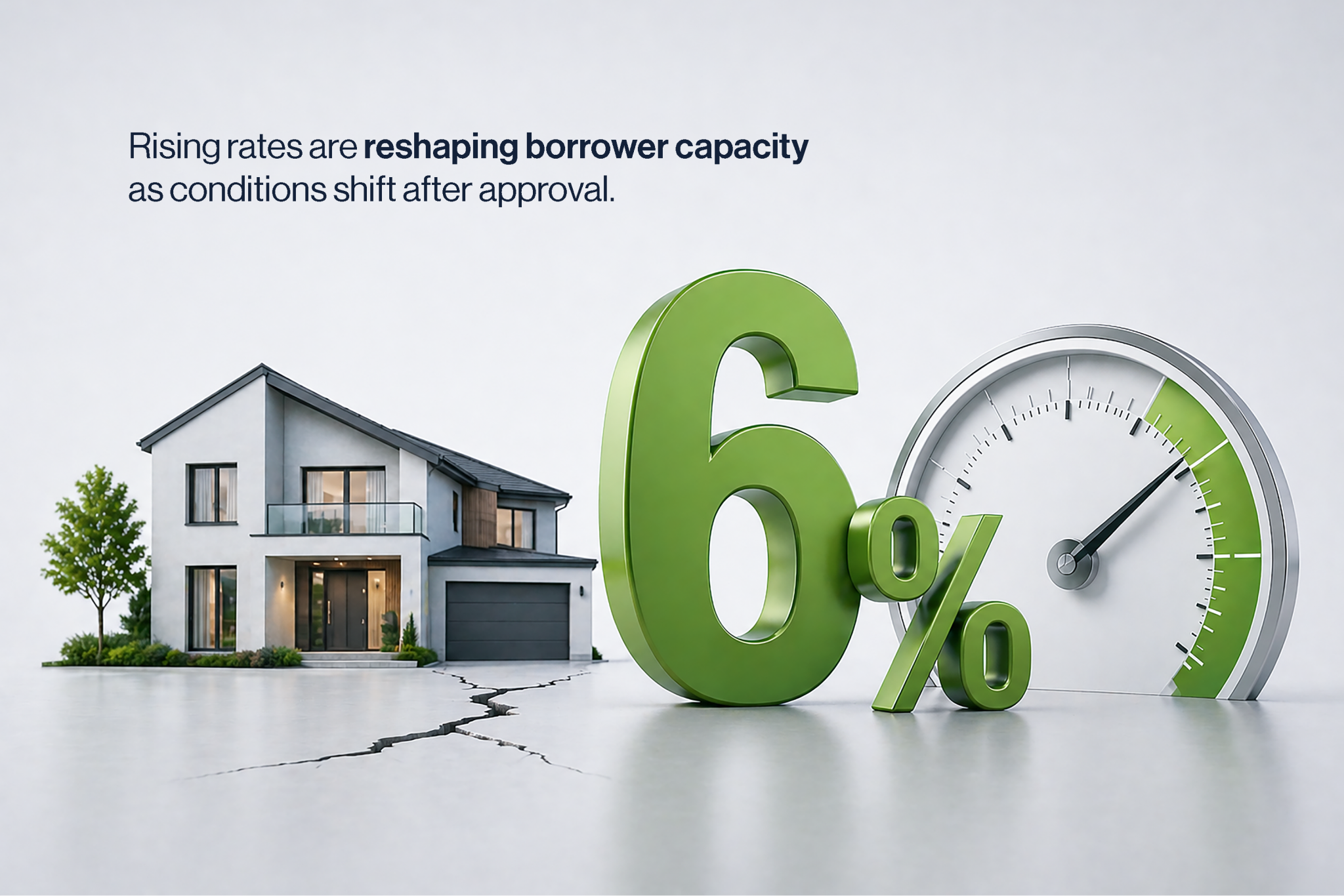
As of April 2026, variable home loan rates have moved beyond 6 per cent, with 6.01 per cent emerging as a baseline across many lender portfolios. Only weeks earlier, more than 20 lenders were offering fixed rates below 5.50 per cent, highlighting the speed of repricing in the current market.
What matters more than the rate itself is the lag in its impact. Many borrowers are only now transitioning into higher repayment environments, meaning affordability pressure is building after deals have already been assessed.
The implication for lenders and brokers is immediate.
The borrower assessed at application is no longer the same borrower at settlement.
A borrower approved in early March may, by April, be managing an additional $400 to $600 per month across repayments and living costs. The deal still works, but the buffer that supported it has narrowed.
For lenders, this shifts the risk from credit policy to timing. For brokers, it introduces uncertainty in deal progression and client commitment.
Navigating this requires a shift in behaviour.
Rather than relying on the original assessment, stronger lenders are rechecking borrower positions closer to documentation, treating serviceability as something that moves, not something that is fixed.
From a legal lending perspective, timing and data integrity become critical at this point. When borrower conditions shift between application and documentation, lenders need confidence that the information used to produce legal documents reflects the borrower’s current position, not one that has already changed.
In practice, this means ensuring instructions, borrower details, and financial assumptions are aligned and refreshed before documentation is produced. Where this discipline is applied, lenders are seeing fewer late-stage changes, reduced rework, and stronger continuity between approval and execution.
Brokers who stay closer to their clients through this period are identifying pressure earlier, allowing them to reposition deals before they become unstable.
Because in this market, it is not the approval that is at risk.
It is what happens next.
Cost of Living Impact on Borrowing Capacity Australia 2026: Inflation, Fuel Prices and Household Pressure
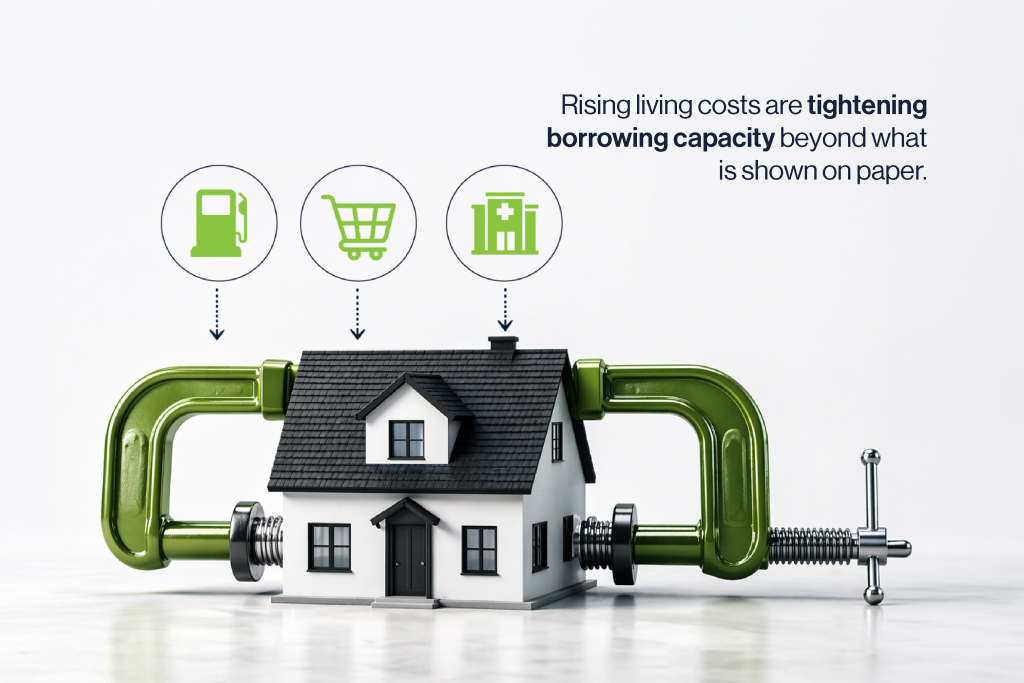
Fuel above $2.55 per litre. Inflation above 5 per cent. Health insurance rising 4.41 per cent.
These are not abstract figures. They are showing up directly in borrower behaviour.
A borrower who previously demonstrated strong surplus income may now be adjusting spending, delaying decisions, or becoming more cautious as financial pressure builds. Not because they fail serviceability, but because their confidence has shifted.
The implication is subtle but important.
Affordability is no longer just about what a borrower can prove on paper. It is about what they are comfortable sustaining in a changing environment.
For lenders, this introduces a gap between assessed capacity and real-world behaviour. For brokers, it means deals can stall or fall over even when they technically qualify.
Navigating this requires a more grounded view of affordability.
Leading lenders are moving beyond declared expenses and factoring in how rising costs are actually impacting borrower behaviour.
This shift is also influencing how loan structures are documented. Where borrower capacity is tighter, clarity around obligations, borrower entities, and security positions becomes more important. Ambiguity in documentation that may have been manageable in softer conditions can create friction when affordability is under pressure.
A structured approach to legal documentation helps ensure that what has been approved is clearly and accurately reflected, reducing the risk of misalignment as borrower conditions evolve.
Brokers who are actively checking in with clients during the process are better positioned to sense hesitation early and adjust accordingly.
Because in 2026, affordability is not static.
It is influenced by how borrowers respond under pressure.
Mortgage Approval vs Settlement Risk Australia 2026: Why Loan Deals Are Falling Over Pre-Settlement
One of the defining shifts in the current market is where deals are breaking.
It is no longer at approval. It is happening between approval and settlement.
As borrower conditions evolve, deals that once looked stable can begin to soften, often quietly and late in the process.
A commercial borrower, for example, may still meet credit criteria but reconsider proceeding as funding costs rise and margins tighten. An owner occupier may hesitate as monthly commitments increase beyond what they expected.
The implication is clear.
Approval is no longer the point of certainty.
Settlement is.
This introduces conversion risk as a central challenge, where deals fall away not because they fail, but because they no longer hold together.
Navigating this requires active deal management.
Lenders who are maintaining visibility across the pre-settlement phase, reconfirming positions, staying engaged, and addressing changes early are seeing stronger conversion outcomes.
This is also where legal lending plays a more active role. The period between approval and settlement is where credit decisions are translated into enforceable documentation. If that translation is not precise, delays and inconsistencies can emerge at the point where borrower conditions are already tightening.
Lenders who apply structured documentation processes during this phase are better able to maintain momentum, minimise disruption, and reduce the risk of deals falling away late in the cycle.
Brokers who remain connected to clients during this period are better able to manage expectations and keep deals moving.
Because in this market, passive progression is no longer enough.

Borrower Behaviour Trends Australia 2026: Refinancing Activity, Rate Sensitivity and Loan Stability
Borrowers in 2026 are more responsive, more aware, and more willing to act.
With many now sitting on rates above 6 per cent, refinancing is increasing, not as an opportunity play, but as a necessity.
Borrowers are reassessing loyalty, acting earlier, and making faster decisions to manage cash flow.
The implication for lenders is retention risk.
Existing clients are more likely to move. For brokers, this creates both opportunity and volatility. Clients are open to change, but less predictable in their decisions.
A borrower who might previously have waited is now actively exploring alternatives before pressure builds further.
Navigating this requires proactive engagement.
Lenders who are identifying and engaging at-risk clients early are better positioned to retain them.
As refinancing activity accelerates, consistency and speed in documentation are becoming more important. Borrowers making faster decisions are less tolerant of delays or repeated information requests.
A structured legal approach that ensures instructions are clear, complete, and aligned from the outset supports smoother execution and reduces friction during refinancing.
Brokers who initiate conversations rather than react to them are capturing refinance opportunities ahead of competitors.
Because in this environment, waiting for the borrower to act means losing control of the outcome.
Lending Risk Factors Australia 2026: How Economic and Global Pressures Are Creating Layered Risk
What defines this market is not just pressure, but complexity.
Interest rates, cost of living, policy uncertainty, and global influences are all interacting at once. Risk is no longer isolated. It is layered.
Deals are not breaking due to a single issue. They are breaking because multiple pressures are aligning at the same time.
The implication is increased fragility.
Even well-structured deals can come under pressure if assumptions are not tested thoroughly. Small changes can have amplified effects.
For lenders, this increases the importance of accuracy and alignment. For brokers, it reinforces the need for clarity and precision in how deals are structured from the outset.
Navigating this requires discipline in structure.
Lenders who prioritise clean data, aligned borrower structures, and clarity across documentation are reducing rework and protecting deal integrity.
In more complex transactions, the role of legal structure becomes even more important. Clear alignment between borrower entities, securities, and obligations provides control in an otherwise uncertain environment.
Where documentation reflects that alignment accurately, lenders are better positioned to manage complexity without introducing additional risk through inconsistency or rework.
Because complexity does not create risk on its own.
It exposes where structure is weak.

How Lenders and Brokers Can Manage Borrower Risk in Australia’s 2026 Lending Environment
Across the 2026 lending landscape, a clear shift is emerging.
Risk is no longer something that can be assessed once and set aside. It must be managed continuously across the life of a deal.
The implication is a change in mindset.
From point-in-time assessment to ongoing risk awareness. From approval-focused thinking to settlement-focused execution.
Lenders and brokers who are performing well in this environment are those who stay close to their deals, revalidate assumptions, maintain engagement, and respond to change as it happens.
Within this shift, legal lending is becoming part of the risk management framework. By ensuring that data, structure, and documentation are aligned from instruction through to settlement, lenders maintain consistency across the deal lifecycle.
This becomes particularly important in a market where borrower conditions are changing, as it reduces the likelihood of breakdown between approval assumptions and executed outcomes.
Because the market is no longer forgiving of static processes.
Future of Mortgage Lending Australia 2026: A Structural Reset in Borrower Capacity and Risk
The lending environment in 2026 is not just another cycle.
It is a reset.
Borrower capacity is shifting. Risk is moving. And the assumptions that once held are no longer reliable.
The implication is simple.
Those who adapt will lead. Those who do not will feel the friction.
Because in this market, success is no longer defined by approval.
It is defined by the ability to deliver certainty at settlement, despite everything changing around it.
It is defined by the ability to deliver certainty at settlement, despite everything changing around it.